The DfE has blogged. Not a crime is it – I do it myself, all the time – but this particular blog post is interesting (unlike most of mine).
The DfE starts by telling us:
In maths we think that all pupils who leave primary school should be fluent in addition, subtraction, long multiplication, and division, and in working with fractions, decimals and percentages.
In English, we think that all pupils should be able to read fluently and write accurately and coherently. These skills set them up to succeed and flourish in secondary school and access a broad and balanced curriculum.
Can’t fault that, can you? We all expect our children to be able to read, write and calculate, it’s plain common sense. But here’s the interesting part, the concerning part:
We’ve made huge progress recently – in 2019, 65% of pupils reached the expected standard in all of reading, writing and maths, compared to 53% in 2016.
Progress? Over a third of children hadn’t reached expected standards in 2019 – pre-pandemic, pre-lockdown learning/covid absences/teachers isolating. Over a third weren’t at the Government’s expected levels then – what will 2022’s figures be like?
So, is it all doom and gloom?
Well, I’m minded to think the situation is like the curate’s egg, good in some parts and fairly grim in others. There is no question that today’s year 6s are hugely disadvantaged compared with the 2019 cohort, and unless we see a concerted effort to drive the number of cases down (by which I mean actually down, not just-not-testing-anymore-so-not-releasing-figures down) we will continue to see disruption. I can’t remember the last time we didn’t have at least one of our own student off sick – actually sick- with Covid. We need to take practical measures: ventilation, masking, and isolation for infectious students/staff, and time for planning for remote delivery to those who are off.
But, and I can’t stress this enough, Covid aside, we need to look closely at the Government’s ‘expected levels.
Expecting a 10-year-old to read, understand and weigh up the value of a text is a solid aim. Expecting them to write coherent, structured texts is also spot on.
But expecting them to understand the subjunctive mood, identify different types of subordinate clauses and to identify determiners – how crucial is any of that? I don’t mean to be rude (especially since you’ve been kind enough to suffer my rantings this far) but have you mastered all those skills? If it makes you fell better I have 2 English degrees and I only discovered what a determiner was when it became part of the Year 4 curriculum.
And the picture is the same if we move on to maths. Numeracy is vital, methods for calculating answers to problems is going to be so important for daily living. But algebra and dividing fractions at 10? Are we really convinced this is an essential expectation to set for these children?
Whenever I hear someone suggest something doesn’t meet expectations, my first thought is ‘are those expectations reasonable?’ Often they are, but not always, and in the case of the SATs Test I think they are unfit for purpose.
So, does it matter whether the Government’s expectations are met? Yes and no. Your child will get through life perfectly well even if they never use the subjunctive correctly – very few people do. But the insidious problem, is the narrowing of the curriculum that is happening in many schools, just to squeeze in more Maths Spelling, Punctuation and Grammar. More is not always better, and more of the same tedious rule-based learning at the expense of science, the arts and PE is just plain wrong. These children have been restricted in their learning through necessity. We shouldn’t be inflicting an unnecessary and unproductively narrowed curriculum simply because consecutive Education Secretaries expect more of our children than we do of ourselves.
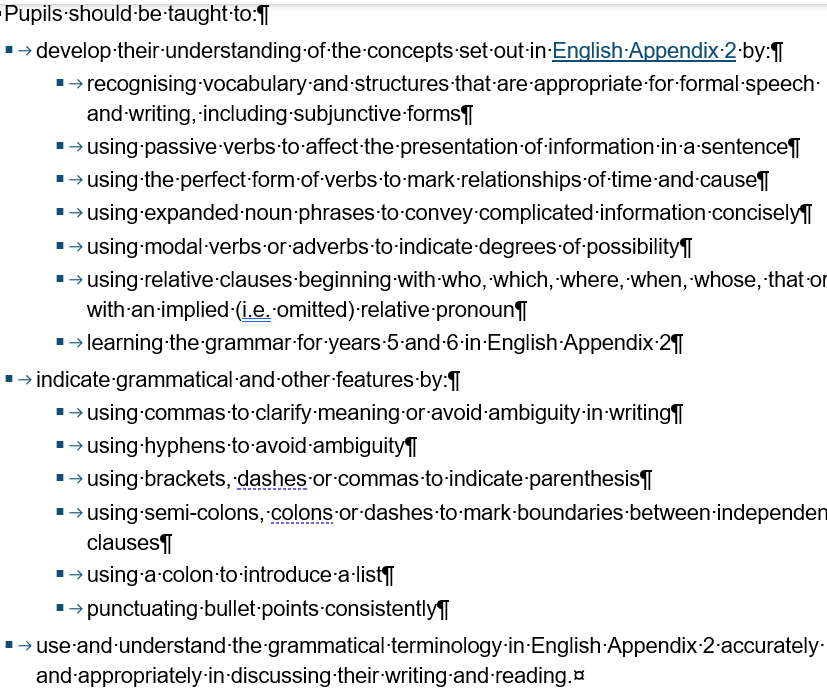
Our focus on literacy and numeracy – what it means in practice – The Education Hub (blog.gov.uk)